
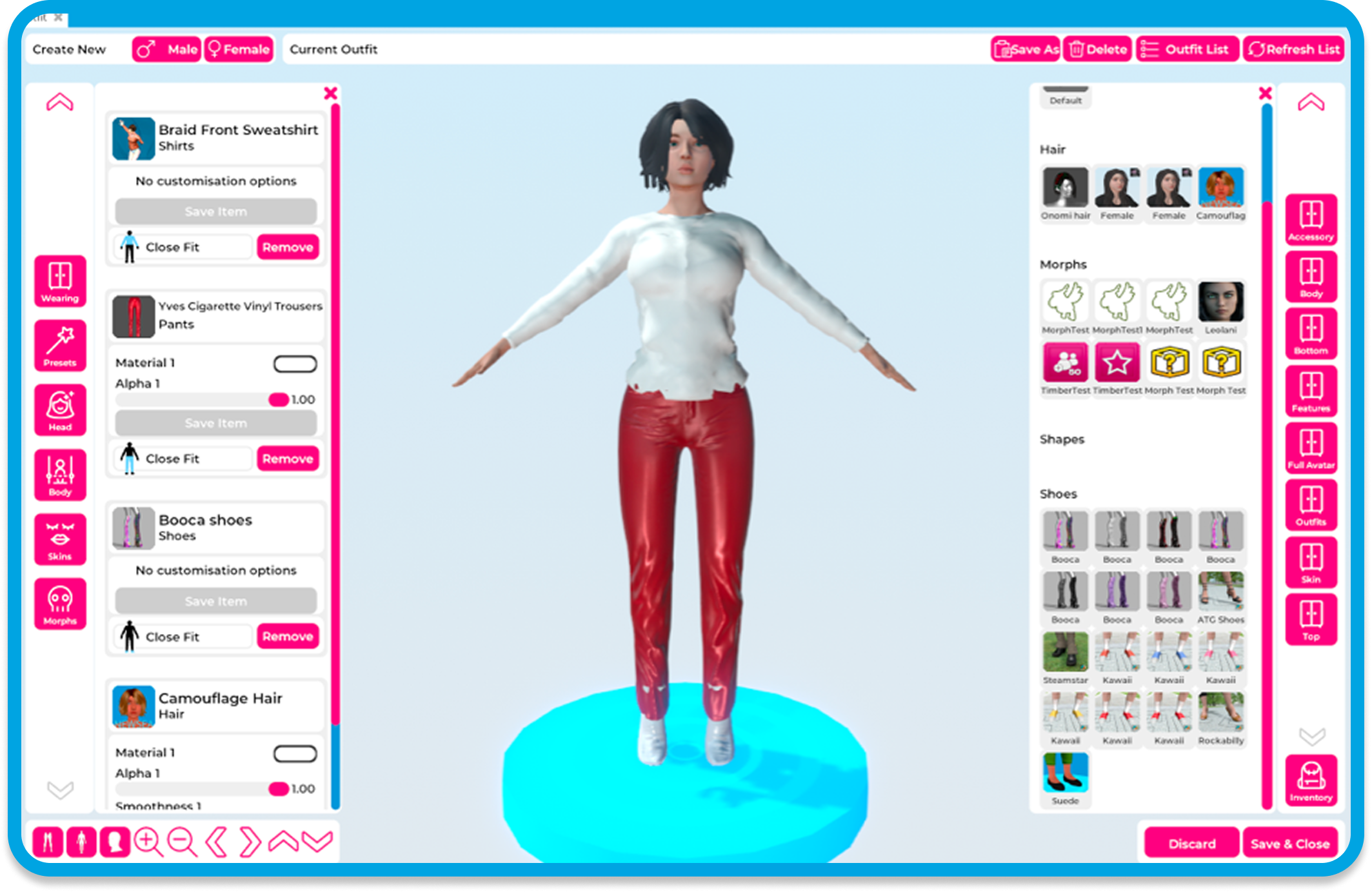
Outfit flow is cumbersome
The task path was too long and caused user drop-off.
A single avatar edit required jumping across multiple tabs and hidden steps, making first-time setup and outfit customization costly to learn.


UI/UX Case Study
Lead UX designer, responsible for the PC redesign and the app experience from 0 to 1.
Sinespace by Sine Wave is a cross-platform virtual social world that supports VR and PC. Users can create content, trade virtual goods, and socialize with others through avatars.
To strengthen the brand's immersive identity, I rebuilt the information architecture, simplified critical flows, and unified the interaction language to connect the desktop and app experience into one cohesive product system.
This project rebuilt the information structure, simplified the core flow, and established a unified design language to create an immersive and efficient cross-platform experience.
A single avatar edit required jumping across multiple tabs and hidden steps, making first-time setup and outfit customization costly to learn.
Core work areas such as editing and shopping were split across both sides of the interface, so users had to repeatedly scan the screen and switch focus.
Buttons, icons, and panel treatments lacked visual consistency, which increased uncertainty and interrupted the immersive feeling of the product.
Through large-scale audience segmentation, I identified three core creator profiles with the highest strategic value and used them to define the redesign priorities.

Core need: support the full loop of creating, showcasing, and monetizing identity-driven virtual goods.

Core need: a platform that supports complex UGC workflows and efficient transactions for diverse virtual goods.

Core need: present personal style through silhouettes, accessories, and spatial identity to strengthen social recognition.
The research confirmed that creator-led segments account for a smaller share of users but a much larger share of potential value. The redesign therefore prioritizes creation, trade, and rich self-expression while keeping the interface approachable for younger social users.
I restructured the avatar editing experience around three clear usage scenarios to make exploration faster, customization deeper, and the creator workflow more focused.

By anchoring the key editing workspace, the design removes left-right confusion, lowers cognitive load, and helps users focus on creation.
A simplified mode supports fast changes for social display, while an advanced mode preserves fine controls for creators with professional needs.
The end-to-end flow connects identity setup, styling, and trading so users stay immersed instead of feeling like they are moving between disconnected tools.
New advanced features such as avatar face sculpting, makeup changes, and body proportion editing establish a complete professional avatar creation scenario. This directly serves the core need for high-freedom creation from social creators and game creators, and lays the groundwork for the virtual goods economy.


